

Your ductwork likely needs professional attention when you notice uneven temperatures between rooms, unexplained energy bill increases, unusual noises from vents, visible damage, or persistent indoor air quality problems related to ductwork replacement. At Mechanical Extremes Heating & Cooling, LLC, we assess all of these before recommending the next steps.
How Does Ductwork Age Affect Its Performance?
Ductwork does not last forever. Sheet metal ducts hold up for 20 to 25 years when properly maintained. Flexible ductwork typically lasts 10 to 15 years before kinking or tearing restricts airflow.
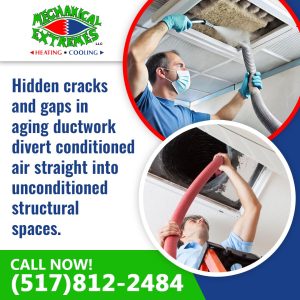
As ducts age, seals and joints gradually break down. What starts as a minor gap becomes a consistent source of conditioned air loss before it reaches your living space. If your ductwork is approaching the 15-year mark, an inspection with a qualified HVAC company is worth scheduling, even without obvious symptoms.
For many homeowners, understanding when to consider ductwork replacement can prevent larger issues and maintain energy efficiency.
What Are the Warning Signs to Watch For?
Uneven Temperatures Room to Room
If one bedroom stays warm while another stays cold, regardless of your thermostat setting, the problem is rarely the equipment. Inconsistent temperatures typically point to duct leaks, blockages, or sections never properly sized for the rooms they serve, especially after a home addition, renovation, or new HVAC installation.
Rising Energy Bills Without a Clear Cause
When conditioned air escapes through duct gaps, your furnace or air conditioner runs longer to compensate, and that shows up on your utility bills. If costs have climbed without a change in usage habits, deteriorating ductwork is worth investigating.
Unusual Noises From the Vents
Rattling often points to loose joints or sections that have separated. Whistling typically indicates air forcing through gaps. Persistent noises that were not there before suggest the system is under strain or losing structural integrity.
Visible Physical Damage
Check any exposed ductwork in basements, crawlspaces, or attics for rust, holes, disconnected sections, or kinked flex duct. Each of these reduces airflow and strains your HVAC equipment.
| Visible Sign | What It Usually Means |
| Rust or corrosion | Moisture exposure; possible seal failure |
| Disconnected sections | Air escaping into unconditioned space |
| Crushed or kinked flex duct | Restricted airflow to that room |
| Sagging or collapsed sections | Structural deterioration; replacement needed |
Worsening Indoor Air Quality or Persistent Dust
Leaking ducts pull in dust, debris, and allergens from attics or crawlspaces and distribute them throughout your home. The U.S. EPA identifies visible mold growth inside ducts, pest infestation, and excessive debris release from supply registers as conditions warranting immediate professional evaluation. When insulated ductwork becomes wet or moldy, the EPA states it cannot be effectively cleaned and must be replaced.
Redesign vs. Replacement: What Is the Difference?
Redesign is appropriate when the ductwork is still structurally sound, but the layout no longer fits the home, after an addition, floor plan change, or new HVAC system. Rerouting or resizing specific sections may fully resolve the problem.
Replacement is the right call when ducts are extensively deteriorated, infested, or contaminated beyond what repairs can correct.
At Mechanical Extremes Heating & Cooling LLC, our HVAC contractors in Cement City, MI, evaluate both before making a recommendation. The goal is the right solution for your home, not the most expensive one.
Frequently Asked Questions
- Can I check my ductwork condition myself?
You can inspect exposed sections in basements, attics, or crawlspaces for rust, disconnected joints, or crushed flex duct. However, most ductwork runs through walls and ceilings. Professional pressure testing and airflow measurement give a complete picture that visual checks cannot. - Should ductwork be replaced at the same time as a new HVAC system?
Not always, but worth evaluating. If existing ducts are old, damaged, or not sized for the new equipment, they will limit the new system’s performance. An HVAC company can assess compatibility before installation. - How long does a ductwork inspection take?
A visual inspection of accessible areas takes one to two hours. A full evaluation with pressure testing and airflow measurement at each register runs two to four hours, depending on the home’s size and layout.
Not Sure What Your Ducts Need? We Can Help.
If any of these signs sound familiar, the next step is a professional assessment. Mechanical Extremes Heating & Cooling LLC has served Lenawee, Jackson, and Hillsdale counties since 2009, providing heating and cooling services near you across Cement City, MI, and nearby areas. Call us at (517) 812-2484 or email stacey.mechext@gmail.com. Our HVAC contractors are available 24/7.